Including Funding rounds, Bull / Bear thesis, Stock + earnings, Roster changes, Patents, News, and Open roles.
Already subscribed? Sign in →
Dan Ceperley holds a PhD in electrical engineering from UC Berkeley. Before co-founding LeoLabs, he worked at SRI International, where he was program director for space debris tracking, deputy director of the Ocean and Space Systems Center, and supervisor for the Allen Telescope Array. He co-founded LeoLabs in 2016 as a spinout of SRI International to build commercial phased-array radars that track satellites and debris in low Earth orbit, and served as the company's CEO before transitioning to a chief operating officer role when Tony Frazier was appointed CEO in 2024.
Michael Nicolls is a radar engineer who, before co-founding LeoLabs, built phased-array radars to study the ionosphere at SRI International. He co-founded LeoLabs in 2016 alongside Dan Ceperley and Edward Lu, bringing the radar and signal-processing expertise behind the company's global network of ground-based phased-array radars. As CTO he leads the technology that lets LeoLabs detect and track objects in low Earth orbit, including small debris, independent of government sensors.
Dr. Edward Lu is a physicist, engineer, pilot, and former NASA astronaut whose 12-year NASA career included flights aboard the Space Shuttle, Soyuz, and the International Space Station, logging more than 206 days in space. He co-founded the planetary-defense nonprofit B612 Foundation in 2002, and went on to co-found LeoLabs in 2016 to commercialize space-debris tracking and collision-avoidance services. He brings a long-standing focus on protecting satellites from debris and Earth from asteroid impacts to the company's mission of mapping the increasingly congested low-Earth-orbit environment.
No articles ingested yet for LeoLabs. Once the hourly news pipeline is live, every article the classifier tags as mentioning this company appears here with its one-line AI summary and sentiment.
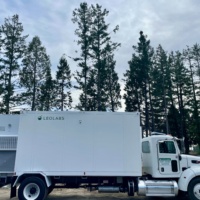
A global network of ground-based, S-band phased-array radars purpose-built to detect and track objects in low Earth orbit, including small debris down to roughly 2 cm. The network spans multiple sites across the U.S., New Zealand, Costa Rica, Australia, the Azores, and Argentina, providing persistent, 24/7 coverage independent of government sensors. The raw radar measurements feed LeoLabs' catalog of orbital objects, enabling commercial and government operators to source tracking data they do not have to collect themselves.
A cloud-delivered software platform that turns LeoLabs' radar data into operational services: conjunction screening, collision-avoidance alerts, orbit determination, and monitoring of adversarial space activity. Satellite operators, insurers, and defense agencies use it to assess collision risk, plan avoidance maneuvers, and maintain custody of objects in a crowded LEO environment. AI-driven analytics flag anomalous behavior and new launches, supporting both commercial fleet safety and national-security space-domain-awareness missions.
4 patents on file, but none with both an extractable figure and an abstract on Google Patents yet.
We don't have a live feed for this company's ATS. Their careers page has every open role.
View all careers ↗