Including Funding rounds, Bull / Bear thesis, Stock + earnings, Roster changes, Patents, News, and Open roles.
Already subscribed? Sign in →
Jonny Dyer holds BS and MS degrees in mechanical engineering from Stanford University and began his career as an engineering intern at Blue Origin and SpaceX. From 2009 he served as chief engineer at Skybox Imaging, the first venture-backed small-satellite company, leading development of what was then the largest constellation of high-resolution imaging satellites; Skybox was acquired by Google for about $500M in 2014. At Google he led the Google Maps data-collection team behind Street View cars and aerial platforms, and he later served as senior director of engineering at Lyft overseeing autonomous-vehicle development. Dyer co-founded Muon Space in 2021 and serves as CEO, building end-to-end Earth-observation satellite constellations.
Dan McCleese is a planetary scientist who served as Chief Scientist at NASA's Jet Propulsion Laboratory and was Principal Investigator for the Mars Climate Sounder instrument. He also chaired the MethaneSAT Science Advisory Group at the Environmental Defense Fund, bringing deep expertise in atmospheric and climate sensing. He co-founded Muon Space in 2021 and serves as Chief Scientist, helping define the company's climate- and science-focused Earth-observation missions.
Paul Day is a spacecraft-production engineer who built the original Skybox Imaging satellites and led satellite production at Terra Bella and Planet, and contributed to developing Apple's Emergency SOS via Satellite feature. He co-founded Muon Space in 2021 and serves as VP of Spacecraft Production (and VP of Engineering), leading hardware development and spacecraft integration and establishing the high-throughput production workflows central to the company's manufacturing approach.
Reuben Rohrschneider is a mission-systems engineer who spent his earlier career at Ball Aerospace, where he worked as a principal mission systems and architecture engineer and as chief engineer for the MethaneSAT mission, with expertise in guidance, navigation and control, entry and aerocapture systems, and satellite instrumentation. He co-founded Muon Space in 2021 and serves as Chief Mission Architect, designing the company's mission-optimized Earth-observation constellations.
Pascal Stang is an engineer who served as an avionics architect at Skybox Imaging, led vehicle technology as a tech lead for Google X's Project Loon high-altitude internet platforms, and directed autonomous-vehicle platform work at Lyft's self-driving division. He co-founded Muon Space in 2021 and serves as chief technology officer, leading the company's spacecraft and systems technology development.
No articles ingested yet for Muon Space. Once the hourly news pipeline is live, every article the classifier tags as mentioning this company appears here with its one-line AI summary and sentiment.
Halo is Muon Space's standardized satellite bus and end-to-end systems platform, designed so the company can rapidly configure mission-optimized Earth-observation spacecraft around a customer's specific sensor and orbit rather than building from scratch each time. Muon pairs Halo with in-house spacecraft software, ground systems, and data pipelines, offering customers a single vertically integrated provider from instrument to delivered data. The platform underpins Muon's commercial and government constellations, and the company has expanded it with an acquired propulsion capability to scale satellite production for larger fleets.
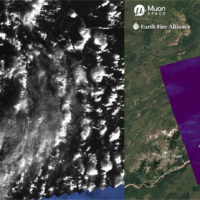
FireSat is a planned constellation of more than 50 satellites dedicated to detecting and tracking wildfires globally, developed by Muon Space with Google Research and the nonprofit Earth Fire Alliance. Built on Muon's Halo platform with custom multispectral infrared instruments, FireSat is designed to spot small, early-stage fires roughly the size of a classroom and revisit them frequently, giving firefighters far earlier warning than current systems. A protoflight satellite launched and returned its first wildfire imagery in 2025, with the first operational phase of three satellites planned to follow.
We don't have a live feed for this company's ATS. Their careers page has every open role.
View all careers ↗