NVIDIA (NVDA) is a publicly traded AI Accelerators company founded in 1993 and based in Santa Clara, United States.
| Date | Stage | Amount | Valuation | Lead investors |
|---|---|---|---|---|
| Jan 22, 1999 | IPO | $42M | — | — |
| Jan 1, 1996 | Undisclosed | $5M | — | Sega |
| Jan 1, 1993 |
| Seed |
| $2M |
| $6M |
| Sequoia Capital, Sutter Hill Ventures |

DEMVal tool detects six flaws in error models from NVIDIA, Riverlane and Microsoft Quantum.

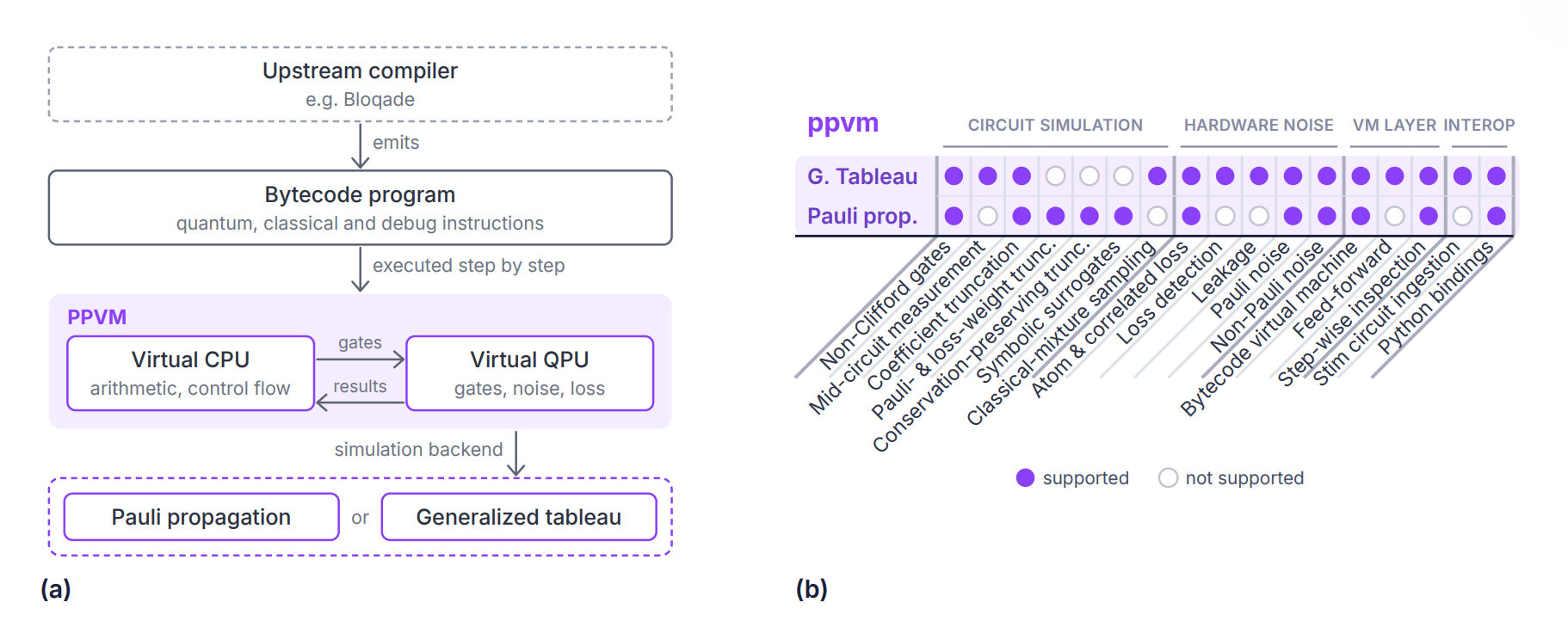
QuEra and NVIDIA release PPVM, an open-source digital-twin simulator for early fault-tolerant neutral-atom quantum processors.

Quantum Motion and NVIDIA integrate a prototype CUDA-Q backend into the open-source QUICHE quantum chemistry interface, validated on the Fe(SH)4− iron-sulfur complex.

Vendavo runs a 15-qubit quantum amplitude estimation simulation on NVIDIA CUDA-Q to model B2B rebate budget breach risk, as a proof of concept.

Analysis argues data center AI chip demand could shift market position between Broadcom and Marvell.
NVIDIA and Microsoft expand their AI partnership from Azure data centers to Windows PCs.
Nvidia's flagship data-center AI GPU architecture, the B200 packs 208 billion transistors across two reticle-limited dies fused into one chip via a 10 TB/s NV-HBI link. The GB200 Grace Blackwell Superchip pairs two B200 GPUs with a Grace CPU. Sold as the GB200 NVL72 rack-scale system connecting 72 GPUs over fifth-gen NVLink into a single coherent compute domain, it targets trillion-parameter LLM training and real-time inference for hyperscalers and AI labs.
The Hopper-architecture H100, and its higher-memory H200 successor, became the de facto standard for frontier model training and inference. The H100 offers fourth-generation Tensor Cores, a Transformer Engine with FP8 precision, and 3 TB/s HBM3 bandwidth; the H200 adds 141 GB of faster HBM3e. Connected via NVLink and deployed in DGX/HGX systems, these GPUs powered the bulk of large-language-model compute through 2023-2024.
Nvidia's parallel-computing platform and programming model, CUDA is the software moat underpinning its hardware dominance. It exposes GPU parallelism to developers through C/C++/Python and a vast library ecosystem (cuDNN, cuBLAS, TensorRT, NCCL) that virtually every AI framework targets. The accumulated software lock-in, more than raw silicon, is widely cited as Nvidia's most durable competitive advantage in AI compute.
A comprehensive platform of APIs, SDKs, and microservices for building and deploying 3D applications and physical AI simulations. Built on OpenUSD standards, Omniverse enables developers to create industrial digital twins, robotics simulations, and collaborative environments with real-time physics accuracy, ray tracing rendering, and multi-GPU acceleration. The platform supports integration with industry-standard tools including CAD software and features cloud-native deployment options for enterprise digitalization workflows.
A GPU-accelerated streaming runtime that delivers high-fidelity extended reality (XR) experiences across AR and VR devices via 5G and Wi-Fi networks. CloudXR enables offloading computationally intensive spatial workloads from headsets to cloud-based servers, providing low-latency, adaptive streaming with foveated rendering optimization. The technology supports streaming of photorealistic OpenUSD-based digital twins and professional 3D applications to devices including Apple Vision Pro, Meta Quest, and web browsers.